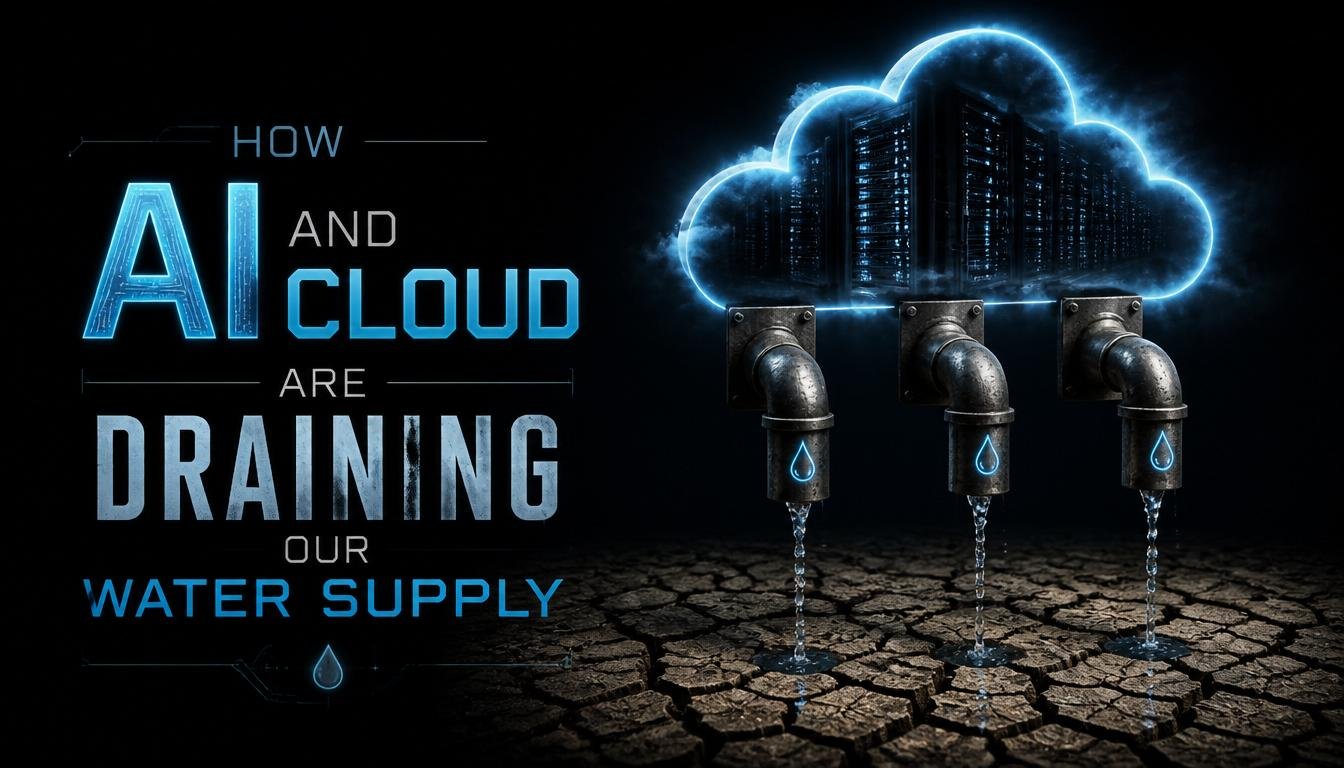
A single data center can consume up to 4 million gallons of water per day to stay cool. But they come with some big trade-offs, like the huge amounts of power to run them and water. For example, every time someone submits a query to an AI model, behind that response are servers that heat up and need to be cooled with clean water. Researchers at the University of California, Riverside, estimate that each 100-word AI prompt consumes approximately 519 mL of water. Between 10 and 50 queries for a medium-sized model can involve the indirect consumption of approximately 500 milliliters of water. To put it in a more measured way, there are billions of AI searches every day. A bottle of water is used for every 10 to 50 of them.
The Hidden Water Cost of Every AI Query:
Thus, most of the water used to cool data centers does not return to the system but instead evaporates and disappears from the local cycle. That’s because it’s not reused in a closed loop, but sent through cooling towers where it absorbs heat from servers and escapes as vapor. In the coming years, the electricity demand of AI-optimized data centers could increase by up to 300%, also raising their indirect water footprint.
Today, data centers make up about 4% of US electricity demand. In just the next 3 years, that’s expected to triple. AI uses enormous amounts of water, and with constant evaporation, it leaves an increasingly visible impact on our resources. So, how is AI wiping out our drinking water?
How Data Centers Actually Use (And Lose) Water:
Artificial intelligence is often perceived as something intangible. However, the data centers that support it already account for nearly 2% of global electricity consumption. Every response generated by an advanced model depends on an infrastructure that operates continuously. Behind every query are massive data centers full of servers that produce constant heat. Some racks exceed 30 to 50 kilowatts of thermal power, so that heat must be continuously dissipated to prevent failures.
To achieve this, large volumes of water are used, often portable. In certain facilities, consumption can reach up to 4 million gallons per day. Therefore, beyond electricity consumption and carbon emissions, AI also has a significant water footprint. Understanding this dimension is crucial, especially if the energy demand of AI-linked data centers could increase by up to 400%.
But then at the same time, somehow a Morgan Stanley projection predicted annual water use for cooling and electricity generation by AI data centers could reach around a,000 billion L by 2028. First, direct water consumption occurs within the data centers themselves. Traditionally, many of these buildings used air cooling systems, a method that still represents around 60% of older facilities.
However, as AI models have become larger and more demanding, the energy density of server racks has increased significantly. Today, some systems exceed 40 kW per rack in high-density facilities, making conventional ventilation insufficient. As a result, liquid cooling systems have been implemented. These systems circulate a coolant over or near the chips, absorbing heat and transferring it to heat exchangers. There, the heat is transferred to water, which in certain large-scale centers can consume more than 3 million L daily, directed to cooling towers.
Why Only Clean, Drinkable Water Works:
In these centers, fans and evaporation reduce the water temperature to restart the cycle. The crucial factor is that the water used must be clean, often portable, or treated to very high standards. This water is taken from the water supply because it has to be clean, fresh water to avoid clogs or bacterial growth. This is a technical requirement as impure water can cause corrosion and reduce system efficiency. Therefore, it is not just any water but a resource that in many regions accounts for less than 3% of available water, competing with human and agricultural consumption.
Additionally, a significant portion of the water is lost through evaporation. When hot water reaches the towers, a fraction turns into vapor, with losses in large facilities exceeding 500,000 L daily. This water does not return to the immediate local system. This has made water scarcity a real risk for the operation of these data centers.
The Indirect Footprint: Electricity Generation and Chip Manufacturing:
Meanwhile, as data centers continue to mushroom, we will need more and more water. So, this is not just an environmental problem; it’s also a technological one because without water, there is no AI. Direct consumption is not the only dimension of the problem. The indirect water footprint can be even larger. To understand it, it is necessary to look beyond the data center building and observe how the electricity that powers it is generated.
Electricity generation, especially in coal, gas, or nuclear plants, can sustain facilities demanding more than 100 megawatts of continuous power. These plants heat water to produce steam that drives turbines and generates electricity. Later, that steam must be cooled, which again involves water-consuming cooling systems. In conventional thermal plants, electricity production can involve an average water consumption of around 2 L per kilowatt hour generated.
As AI data centers increase their energy demand, pressure on power plants also rises. If demand grows by 400% by 2030, the water impact could be amplified in regions reliant on thermal sources. Worldwide data center water consumption is increasing drastically and is expected to more than double by 2030.
Furthermore, this problem continues into the semiconductor manufacturing stage. The industry accounts for nearly 20% of ultra-pure water consumption in some Asian tech hubs. The chips that power advanced models do not appear spontaneously. Their production involves extremely delicate processes that use ultra-pure water to clean silicon wafers and remove microscopic particles. Each wafer may go through more than 1,000 cleaning and chemical treatment steps before becoming a functional chip. Producing a single advanced chip can require thousands of liters of water in different industrial phases.
Moreover, producing ultra-pure water requires even more fresh water as an initial input. In some complexes, total consumption can exceed 10 million L per day, further expanding the indirect water footprint of artificial intelligence.
Social Tensions and Water Scarcity:
In just one day, the average data center could use 300,000 gallons of water to cool itself. The same water consumption as 100,000 homes. Water is involved at multiple levels, and extracting raw materials can require more than 15,000 L per ton. AI does not just consume water when answering a question. It uses water throughout the entire chain, which makes it possible.
This scenario has generated social tensions in various regions. In water-stressed areas, installing data centers has sparked protests where availability drops below 1,700 cubic meters per person per year. Residents question whether it is sustainable to allocate large volumes of water to digital infrastructure when irrigation or domestic use is restricted.
In the United States, the debate focuses on balancing technological expansion with water scarcity and protecting underground water resources. They went through this process called dewatering because of Amazon’s data center construction, where they were actually removing groundwater that people rely on here for their drinking water.
In response to these criticisms, major tech companies have committed to water neutrality, aiming to replenish up to 120% of consumed water. That is returning to the environment an amount of water equal to or greater than what they consume. They are implementing restoration and efficiency projects. And some centers already recycle up to 85% of the water used.
At the same time, technical solutions are being explored, such as immersion cooling, locating centers in cold regions, and using the ocean as a natural heat sink.
Can AI Become Water Neutral?
Residual heat is also being reused for urban heating with projects supplying more than 10,000 homes in certain European cities. However, these initiatives still represent a limited portion of global infrastructure. For example, Microsoft builds data centers in Canada to take advantage of the cold climate and naturally cool servers. So, one of the great things about building in Canada and in colder climates is that we can just use free air cooling from outside air temperatures.
Ultimately, the relationship between artificial intelligence and drinking water is not anecdotal but structural. And the digital sector could reach 8% of global electricity consumption. From training a model to answering a query, electricity, semiconductors, thermal systems, and water are constantly involved. Each increase in processing capacity can double energy demand in just a few years. And each expansion of AI raises questions in a context where more than 2 billion people already struggle to access sufficient water.
Increasingly, these data centers are being built in areas where water is scarce, like Mexico. Consequently, the challenge is not only to make models faster or more accurate, but also to design them to require less energy and water. Artificial intelligence promises to transform the economy, science, and everyday life. However, its sustainable future will depend on how a resource as essential as water is managed.
Bottom Line:
AI isn’t as intangible as it seems. Every ChatGPT response, every generated image, and every automated task comes with a hidden cost: drinking water. A single 100-word prompt consumes half a liter. A single data center can use 4 million gallons per day. And most of that water evaporates, never to return. From cooling servers to generating electricity to manufacturing chips, the AI industry is quietly draining the same water resources that communities and farms rely on. Tech giants promise water neutrality and recycling, but with demand expected to triple by 2030, those solutions aren’t keeping pace. The hard truth is simple: without water, there is no AI. And if the industry doesn’t fix this fast, the most transformative technology of our era will run dry.
FAQs:
1. How much water does a single 100-word AI prompt consume?
Approximately 519 mL, or about a bottle of water.
2. How much water can a single data center use per day?
Up to 4 million gallons per day.
3. Why can’t data centers use any type of water for cooling?
They need clean, drinkable water to avoid clogs, corrosion, and bacterial growth.
4. How much water does a typical thermal power plant consume per kilowatt-hour?
About 2 liters per kilowatt-hour is generated.
5. What is “water neutrality” in the context of tech companies?
Companies aim to replenish up to 120% of the water they consume back to the environment.
6. How many people globally already struggle to access sufficient water?
More than 2 billion people.