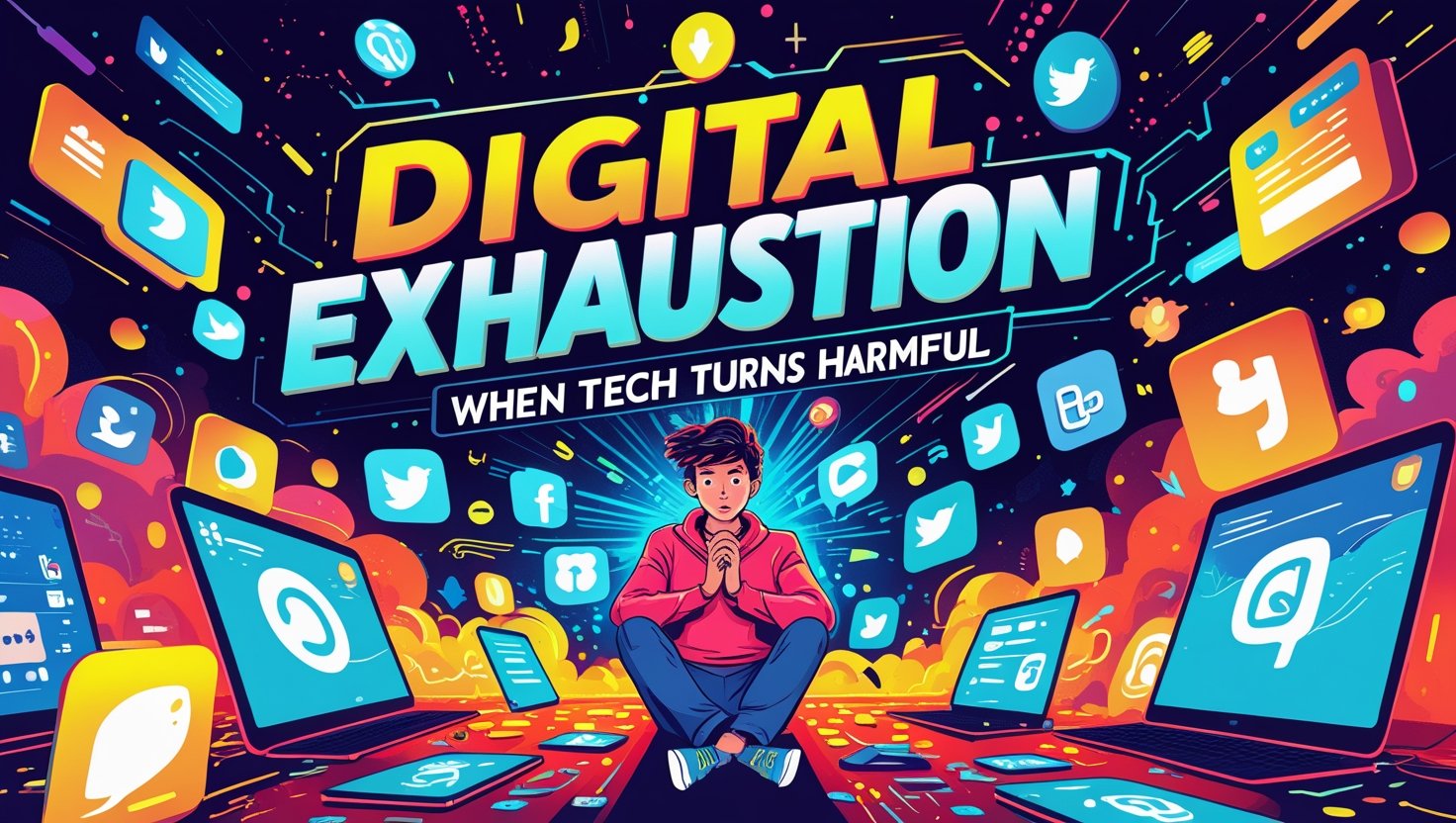
Digital Exhaustion | When Tech Turns Harmful
We have a million words for being tired from physical labor. But we’re missing the word for the unique exhaustion that comes from living inside our computers. I’m calling it Digital Exhaustion. It’s not burnout, that’s a deeper, longer-term crisis. This is the daily drain. The fog. The feeling that your thoughts are made of sludge by 3 PM. I thought it was my fault, a personal failure of focus and discipline. After a breaking point, I realized I was wrong. It’s not us. It’s the way we’re forced to use technology that is, quite literally, designed to exhaust us.
When Every Ping Feels Like a Nudge Off a Cliff:
Let’s talk about the noise. Not sound, but the digital noise. The constant, low-grade hum of interruption that defines the modern workday.
It starts innocently enough. A little ding from Slack. A calendar alert for a meeting in 10 minutes. An email notification. A “like” on LinkedIn. Each one is a tiny, neural interruption. You don’t even have to act on it. The mere awareness that it’s there, the little red bubble with a number in it, pulls a thread in your concentration.
Scientists have a name for the cost of these switches: cognitive load. It’s the mental energy it takes to refocus after an interruption. One study found it can take over 23 minutes to fully regain deep focus after a distraction. Now, multiply that by 50 interruptions a day. You’re not working; you’re just spent. You’re mentally juggling, and your arms are getting tired. The technology that was supposed to make us efficient is instead creating a state of permanent partial attention, and the cost is our mental clarity.
The Tyranny of the “Where Did I Put That?” Hunt:
Here’s the thing nobody tells you: a huge part of our exhaustion isn’t from doing the work. It’s from finding the work.
I once spent 45 minutes looking for a Google Doc. I knew it existed. I knew the approximate name. But was it in My Drive or Shared with Me? Did I put it in the “Q3” folder or the “Project X” folder? Was it shared via the link in a Zoom chat or emailed to me last Tuesday?
This isn’t work. This is digital housekeeping. It’s the unpaid, invisible labor of managing the very systems that are supposed to help us. Every minute spent hunting for a file, deciphering a chaotic Slack thread, or trying to remember which platform a conversation happened on is a minute of mental energy spent. It’s the equivalent of trying to cook dinner in a kitchen where someone keeps hiding all the utensils. You’re exhausted before you even start cooking.
From Human Being to Human Buffer:
Then there’s the pressure to perform. Not just to do your job, but to perform being available and productive.
The pressure to respond to a Slack message within minutes. The anxiety of seeing those three little dots appear and disappear. The unspoken rule is that an email sent at 9 PM deserves a response by 9:05 PM. We’ve become human buffers, constantly processing and responding to streams of digital communication, afraid that if we pause, we’ll be seen as lazy or disengaged.
This performance is utterly draining. It means we’re never truly “off,” even when we’re not actively working. Our brains are stuck in the waiting room, anticipating the next interruption. We’re always “on,” and that switch doesn’t have an off position anymore. It’s a great way to run a server. It’s a terrible way to run a human being.
Fighting Back Without Becoming a Luddite:
So, what did I do? I didn’t move to a cabin in the woods. I declared a cold war on the things causing the most fatigue.
- I Turned Off the Dings. This was the single biggest thing. Every notification on my computer and phone that wasn’t from an actual human being trying to call me? Gone. No banners, no sounds, no badges. I check my apps when I choose to, not when they demand it.
- I Created a “Dumb” Hour. For one hour a day, I close everything. Email, Slack, everything. I put my phone in a drawer. I work on one thing. Just one. The world does not end. The messages are still there when I return. This one hour of deep focus often produces more than the previous five hours of fractured attention.
- I Embraced the “Read Later” Folder. I used to feel compelled to read every article and report the second it hit my inbox. Now I have a folder. Things go in there. I review it on Friday afternoons, a time I’ve accepted is for lower-focus work. It’s okay to not be immediately informed about everything.
- I Talked to My Team. This was the scariest part. I said, “Hey, I’m trying to cut down on distractions to focus better. If it’s urgent, please call me. Otherwise, I’ll be checking Slack at the top of every hour.” The response was shocking. “Oh my god, can we all do that?” We’d all been feeling the same way, silently blaming ourselves.
The Bottom Line:
Digital exhaustion isn’t a personal failing. It’s a human response to an inhuman pace and a chaotic digital environment. The fix isn’t to try harder. It’s to build walls around your attention, to be ruthlessly protective of your focus, and to remember that you are a person, not a processor. Your brain is not an inbox. It’s time we started treating it that way.
FAQs:
1. What’s the difference between digital exhaustion and burnout?
Digital exhaustion is the daily mental drain from tech overload, while burnout is a deeper state of emotional, physical, and mental exhaustion.
2. Will turning off notifications hurt my career?
It signals you value deep work, which leads to higher-quality output; for true emergencies, people can call you.
3. I have to be available for my job. What can I do?
Schedule focused “offline” blocks and communicate them clearly, so you’re available, but on your terms.
4. Is this a real recognized condition?
While not a formal medical diagnosis, it’s a widely experienced phenomenon tied to cognitive overload and tech stress.
5. Can digital exhaustion cause physical symptoms?
Absolutely; it often manifests as eye strain, headaches, poor sleep, and general fatigue from constant mental stimulation.
6. What’s the first step to feeling better?
Start with one change: mute a single chat channel or turn off email notifications for one morning. Small wins build momentum.
